
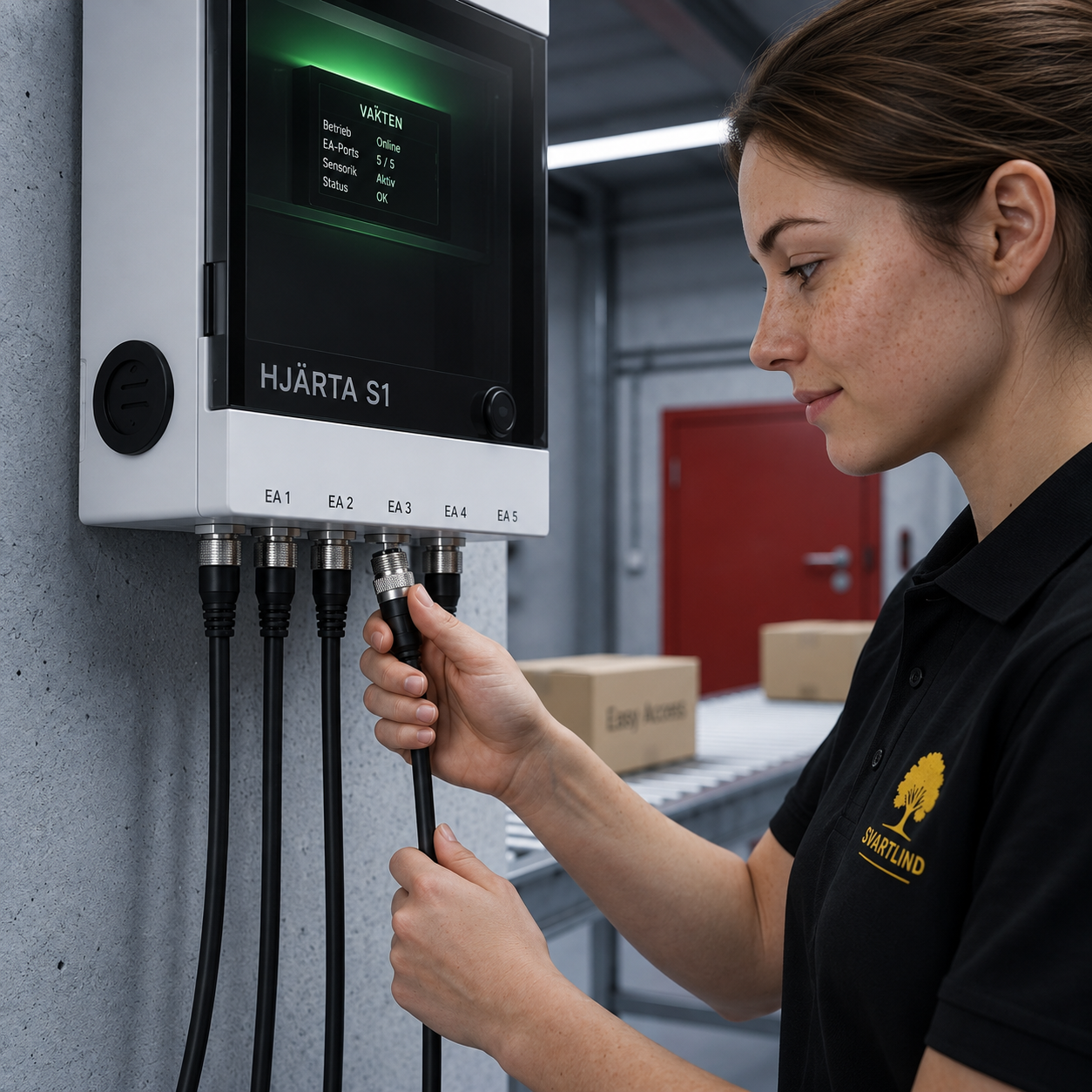
Sensors connect the real environment to HJÄRTA. They detect a state or measured value and provide an electrical signal that HJÄRTA can acquire and pass on to VAKTEN.
It is important to distinguish between the electrical truth and its later technical meaning. An input initially only sees something such as 0 or 1, active or inactive, or a measured value. VAKTEN then turns this into understandable information such as “door closed”, “light barrier occupied” or “temperature 6.2 °C”.
What do 0 and 1 mean for a sensor?
Binary sensors provide two distinguishable states. Technically, these may be represented as 0 and 1, OFF and ON, or open and closed.
The meaning depends on the application. An active input may, for example, mean that a door is closed, a light barrier is interrupted, an end position has been reached or a temperature limit has been exceeded.
HJÄRTA initially acquires only the electrical signal. Its technical meaning and evaluation are defined in VAKTEN.
What types of sensors are available?
Binary sensors provide two states. Typical examples include reed contacts, light barriers, thermostats and limit or proximity switches.
Metric sensors provide a measured value rather than a simple switching state. Examples include thermometers and angular or position sensors.
How are sensors connected through Easy Access?
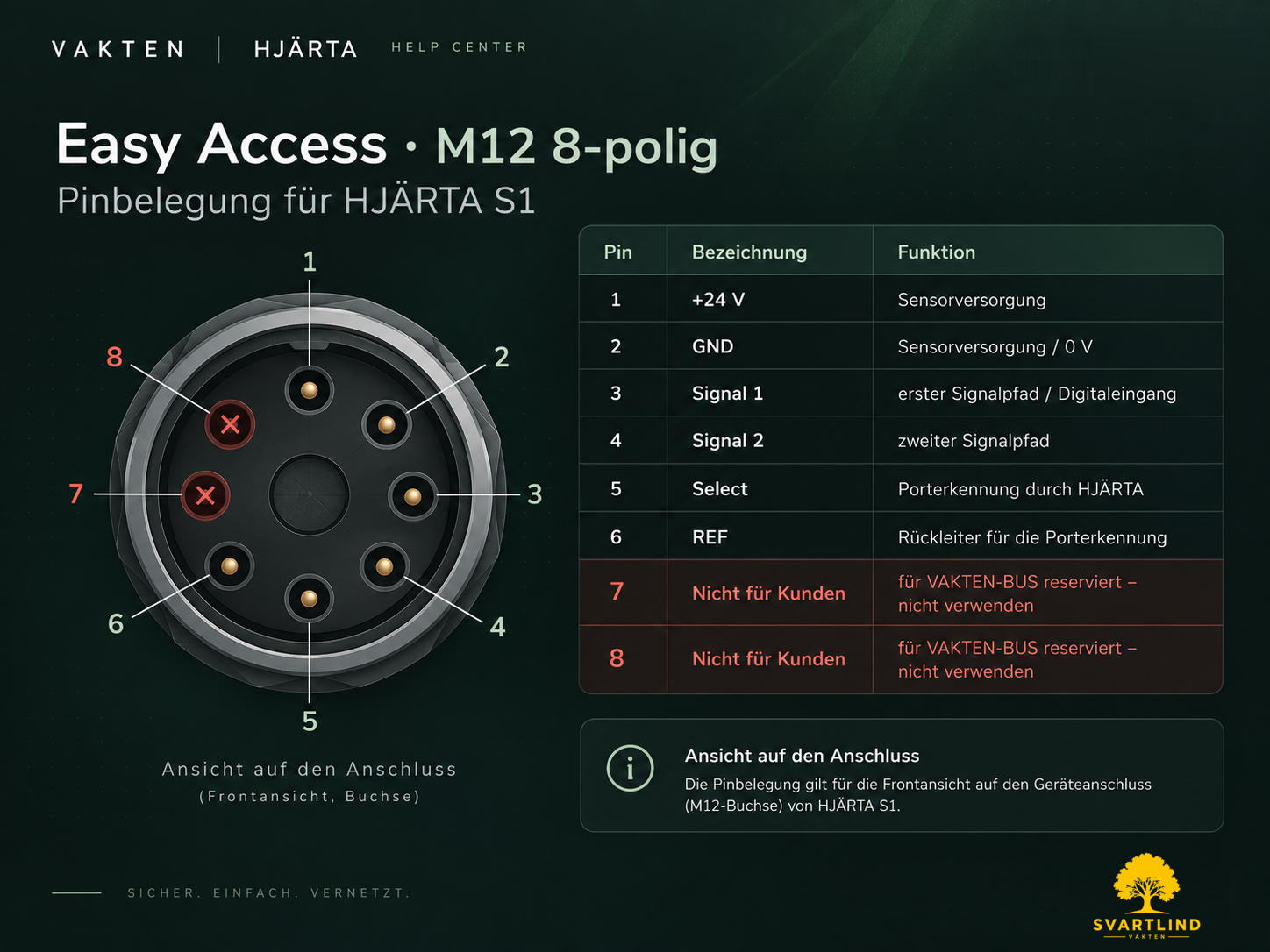
HJÄRTA generally uses 24 V DC on the sensor side. Easy Access provides power and defined signal paths directly through the 8-pin M12 connection.
A suitable sensor or prepared sensor box can therefore be connected directly to an Easy Access port without an additional interface module.
How are external signals connected through Professional I/O?
HJÄRTA S1 Professional provides ten separate Professional I/O signal channels for suitable status outputs from existing systems and other compatible sensors.
Each input is galvanically isolated by an optocoupler. This electrically separates the incoming signal from HJÄRTA's internal logic. Each channel can additionally provide 24 V+ via a second conductor.
Professional I/O channels are not limited to a specific type of system. In VAKTEN, the operational meaning of the captured signal is defined – for example operation, fault, alarm, open or closed.
Why does HJÄRTA use 24 V and optically coupled inputs?
24 V DC is widely used in technical and industrial installations and is well suited to robust sensor connections and longer cable runs.
HJÄRTA inputs are optically coupled. The incoming 24 V signal is therefore acquired with galvanic separation from the internal logic.
In simple terms, the sensor side and internal electronics are electrically separated. Faults, interference or incorrect voltages on one side therefore cannot directly affect the other side.
A short circuit on the sensor side can, however, still affect a shared 24 V supply or other connected loads if they are not separately protected or supplied.
How does a sensor signal become information in VAKTEN?
- The sensor detects a state or measured value.
- HJÄRTA acquires the electrical signal at the assigned input.
- VAKTEN assigns a technical meaning to that signal.
- Rules, targets and tolerances determine how the state is evaluated.
Which sensor fits my application?
The simplest option is a sensor or sensor box prepared for HJÄRTA from the SVARTLIND shop. These components are already matched to HJÄRTA in terms of supply, connection and signal processing.
Third-party sensors can also be used if their electrical characteristics and signal type match the intended connection.
Sensor box
Are wireless sensors available?
Yes. Wireless sensor solutions are available on request.
The appropriate radio technology depends on the environment, range, power supply and required update rate. For standard installations, HJÄRTA deliberately uses wired 24 V sensor technology because it provides clear power supply, robust signal transmission and technically transparent installation.